The global workwear market in 2026 has shifted from simple "uniforms" to high-performance "technical apparel." Sourcing workwear from China now requires a deep understanding of functional fabrics, safety certifications (ISO, EN, ANSI), and the regional clusters that specialize in specific niches. For procurement professionals, the challenge isn't just finding a factory; it's finding a partner capable of maintaining consistent GSM (grams per square meter), color fastness, and durability across 10,000+ units.

Why China’s Workwear Ecosystem Remains the Global Leader in 2026
While some basic garment production has migrated to SE Asia, China remains the dominant force for technical workwear. This is due to its integrated supply chain. In clusters like Shandong and Zhejiang, a factory can source flame-retardant (FR) yarn, specialized zippers, and high-visibility reflective tape within a 50-mile radius.
For the buyer, this means shorter lead times for complex designs and more competitive "landed costs" despite rising labor rates. The 2026 market also emphasizes "smart workwear"—garments integrated with RFID for laundry tracking or moisture-wicking fabrics that meet GRS (Global Recycled Standard) requirements.
Top 10 Workwear Manufacturers in China: Specialized Leaderboard
To help you match your volume and technical needs, we have categorized the top suppliers by their manufacturing strengths.
1. Shandong Weiqiao Pioneering Group
- Specialization: Massive-scale industrial workwear and raw textile integration.
- Best For: Bulk Buyers & Government Tenders.
- Sourcing Suitability: High-volume orders (50,000+ units) where price-per-piece is the primary KPI.
- Limitations: Extremely high MOQs; rigid customization workflows.
2. Dalian Sunfeng Fashion Co., Ltd.
- Specialization: High-end outdoor workwear and technical jackets.
- Best For: Brand Owners (Premium).
- Sourcing Suitability: Buyers needing seam-sealed, waterproof, and breathable work jackets (Gore-Tex style).
- Limitations: Higher price point compared to inland factories.
3. Bosch (China) Safety Garment Co., Ltd.
- Specialization: High-Visibility (Hi-Vis) and PPE-compliant apparel.
- Best For: Sourcing Business & Wholesale Trade.
- Sourcing Suitability: Standardized safety vests and parkas meeting EN ISO 20471 and ANSI/ISEA 107.
- Limitations: Focuses heavily on safety standards; less expertise in "fashionable" corporate wear.
4. Hebei Ruichun Textile Co., Ltd.
- Specialization: Hospitality and Healthcare Uniforms.
- Best For: Small to Mid-sized Buyers & Medical Brands.
- Sourcing Suitability: Anti-microbial scrubs, chef coats, and lab uniforms.
- Limitations: Primarily cotton-based; not suitable for heavy-duty FR industrial gear.
5. Zhejiang Giuseppe Garment Co., Ltd.
- Specialization: Corporate Uniforms and "White Collar" Workwear.
- Best For: Large Corporations & Airline/Banking Sectors.
- Sourcing Suitability: High-end suiting, shirts, and tailored corporate identities.
- Limitations: Higher lead times for bespoke tailoring at scale.
6. Ningbo Shenzhou Group
- Specialization: Performance-knit workwear and logistics apparel.
- Best For: Ecommerce Sellers & Tech-Logistics Firms.
- Sourcing Suitability: Moisture-wicking polo shirts, stretch-cargo pants, and lightweight vests.
- Limitations: High demand makes their production slots difficult to book for new clients.
7. Henan Eastman Garment Manufacturing
- Specialization: Industrial Coveralls and Bib-Trousers.
- Best For: Bulk Importers for Mining and Construction.
- Sourcing Suitability: Heavy-duty poly-cotton blends with reinforced stitching.
- Limitations: Designs are functional and "utilitarian" rather than aesthetically modern.
8. Shanghai XM Group
- Specialization: Flame Retardant (FR) and Anti-Static Fabrics.
- Best For: Oil & Gas / Electrical Utility Buyers.
- Sourcing Suitability: Complex multi-risk protective clothing (Arc Flash protection).
- Limitations: Fabric-focused; the assembly lead times can be longer due to technical testing.
9. Quanzhou Ruibei Clothing
- Specialization: Cold-storage and Extreme Weather Gear.
- Best For: Logistics Chains & Cold-Chain Operators.
- Sourcing Suitability: Thermal insulated overalls and jackets.
- Limitations: Very seasonal production peaks.
10. Shenzhen Dressu Garments
- Specialization: Smart Uniforms and High-Tech Integration.
- Best For: Innovation-focused Brand Owners.
- Sourcing Suitability: Uniforms with integrated RFID or wearable sensors.
- Limitations: Niche pricing and specialized maintenance requirements.
Comparison: Choosing Your Manufacturer Based on Procurement Scenario
| Buyer Type | Primary Concern | Recommended Supplier Type | Typical MOQ |
|---|---|---|---|
| Ecommerce Seller | Lead time & MOQ | Coastal OEM (Ningbo/Shenzhen) | 300 - 500 pcs |
| Bulk Wholesaler | Unit Price/Stability | Inland Conglomerate (Shandong/Henan) | 2,000+ pcs |
| Safety Brand | Compliance (EN/ANSI) | Specialized PPE Manufacturer | 1,000+ pcs |
| Small Buyer | Low Entry Barrier | Specialized Trading Factory | 100 - 200 pcs |
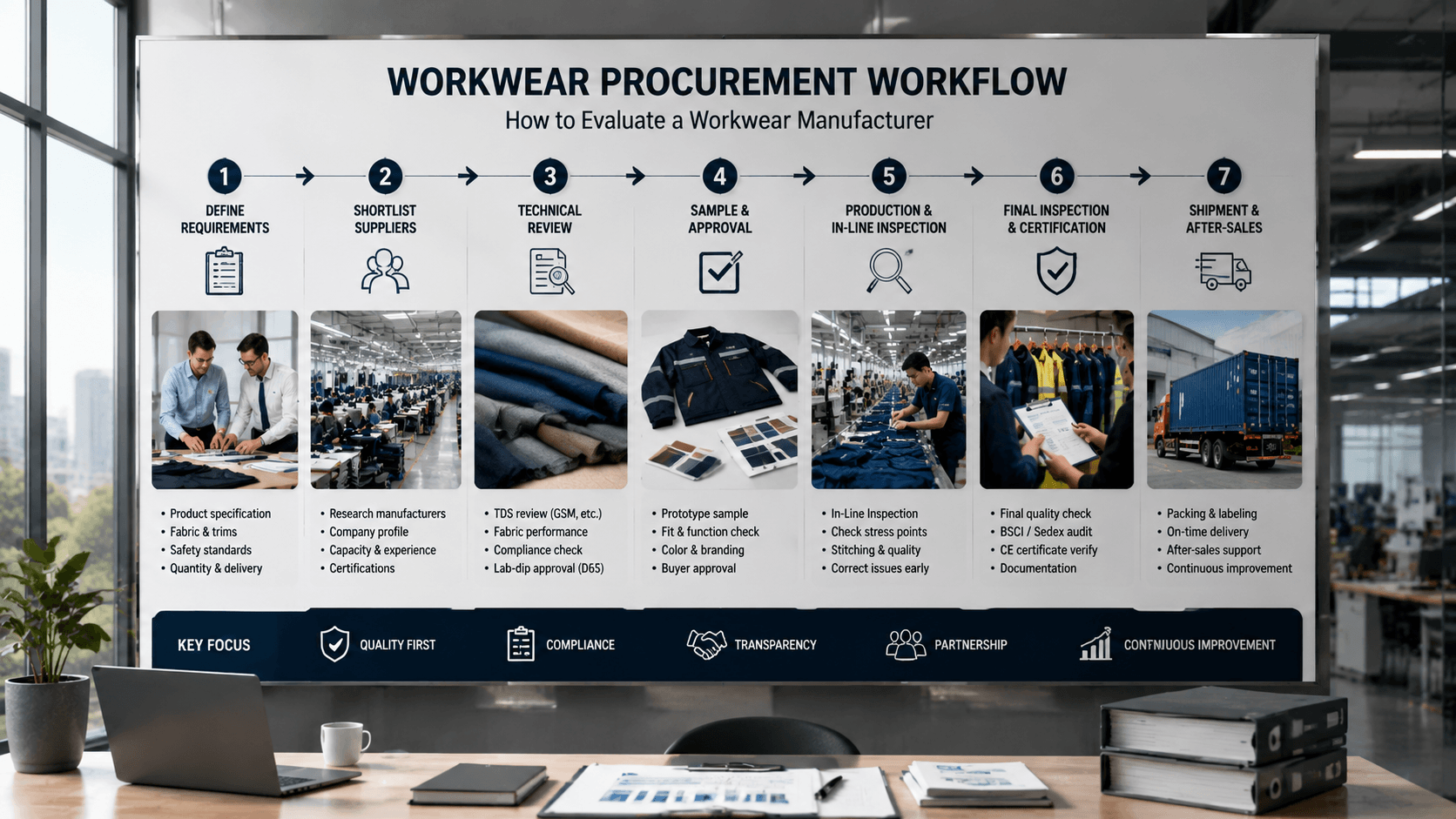
Sourcing Workflow: How to Evaluate a Workwear Manufacturer
In the workwear industry, "cheap" often results in failed seam strength or non-compliant fabric. Follow this evaluation logic to protect your procurement:
- Technical Data Sheet (TDS) Review: Do not just ask for a sample. Request the TDS of the fabric. Check for GSM, pilling resistance, and color fastness to industrial laundering.
- Lab-Dip Approval: For corporate branding, ensure the factory provides a lab-dip (pantone matching) for approval under specific lighting (D65).
- Third-Party Inspection: For BOFU-stage buyers, an "In-Line Inspection" is critical. Since workwear involves many "stress points" (crotch, pockets, zippers), catching stitching errors early saves the entire batch.
- Certification Verification: Ask for a BSCI or Sedex audit report. For safety gear, verify the CE certificate through the notifying body’s database to avoid counterfeit documentation.
The Reality of Logistics: Volumetric Weight vs. Cost
Workwear, particularly winter jackets and heavy-duty coveralls, is high-volume. Many buyers underestimate the shipping costs.
- Sea Freight: Best for bulk (FCL/LCL).
- LDP (Landed Duty Paid): Recommended for US/EU buyers who want the supplier to handle the complex textile tariffs.
- Packaging Tip: Ask your manufacturer about vacuum packaging. It can reduce the volume of parkas by up to 40%, significantly lowering your sea freight costs.
5. Reference Sources
- China National Garment Association (CNGA): Industry data on textile clusters.
- SGS & Intertek: Technical standards for protective clothing (EN ISO 20471).
- Global Recycled Standard (GRS): Verification for sustainable workwear fabrics.
- Customs & Border Protection (CBP): Guidelines on textile import compliance.